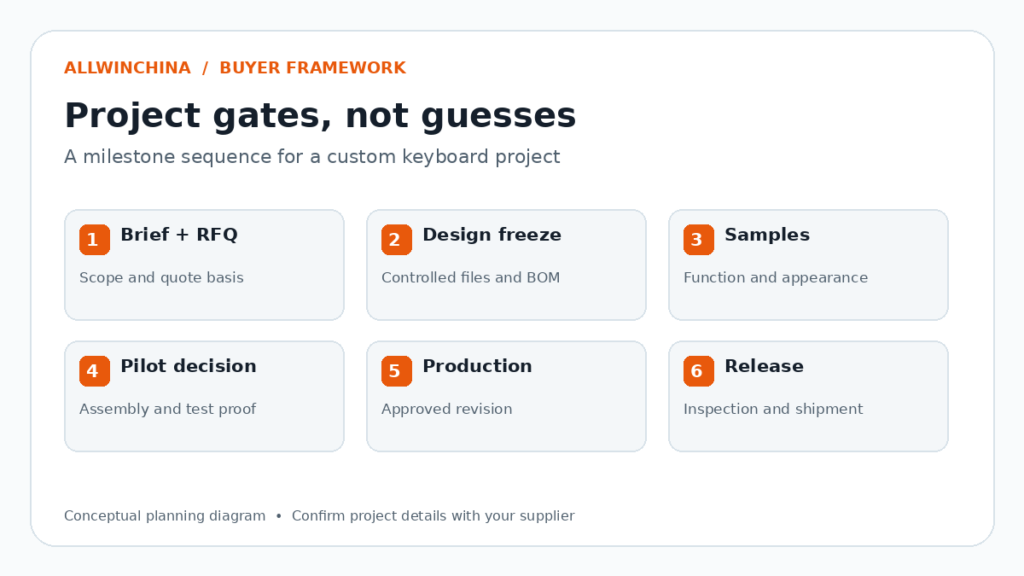
“How long does a custom keyboard take?” has no reliable single answer. An existing platform with limited cosmetic changes and a new keyboard with fresh tooling, electronics and firmware do not share the same critical path. For buyers, the useful question is: which decisions and approvals must happen before the next stage can start? Build the schedule around those gates, then ask suppliers for dates tied to your actual scope.
Gate 1: agree the brief and quotation basis
The first milestone is not “factory found”; it is an RFQ that two suppliers can interpret in the same way. Record layout, connection mode, case and keycap materials, switches, firmware needs, packaging, expected quantity and target market. Identify which decisions are open. Ask for the lead-time assumptions behind each quote, including long-lead components and any new tooling. Use our keyboard OEM RFQ checklist to make these inputs explicit.
Gate 2: freeze the design revision
Once the development route is chosen, give every drawing, BOM, artwork file and firmware specification a revision number. A “design freeze” does not mean no change is ever allowed. It means a change now has a recorded cost and schedule effect. Before authorizing tooling or bulk materials, confirm the final layout, mounting interfaces, keycap profile, legend artwork, connector position and packaging dimensions. A supplier should be able to tell you exactly which revision it will build.
Gate 3: approve functional and appearance samples
Separate engineering questions from cosmetic ones. A functional sample should answer whether the keyboard scans and connects as intended, whether controls and firmware behave correctly, and whether components fit. An appearance sample should answer questions about color, texture, printing, legends, seams and packaging. One sample may serve both purposes, but the approval record should still list each criterion. Ask who will test the sample, what evidence will be shared and how many review rounds are included in the proposal.
Gate 4: decide whether a pilot run is needed
For a new design or a change that affects assembly, a small pilot can reveal process problems before a full run. Define its purpose: confirming assembly instructions, test fixtures, yield reporting, packaging or the supplier’s ability to reproduce the approved sample. Do not assume a pilot is automatically included or that it replaces final inspection. Ask for the pilot quantity, acceptance criteria and decision owner before it begins.
Gate 5: authorize production against controlled inputs
Production should start only after the supplier and buyer agree on the approved sample, current BOM, firmware version, artwork and quality criteria. If a component becomes unavailable, require a substitution request with its impact on function, appearance, cost and timing. A low-friction change-control log is often more valuable than an optimistic schedule that hides changes. The companion keyboard QC plan covers inspection checkpoints.
Gate 6: close inspection and shipment
Reserve time for final testing, defect resolution, labeling, carton checks and shipping documents. Specify who books freight and when risk transfers under the agreed trade term. The ICC Incoterms reference can help clarify that responsibility; it does not substitute for a written purchase agreement. Ask for a packing list and agreed inspection evidence before shipment release.
Turn milestones into a useful schedule
Ask your supplier for a dated plan with an owner, input, output and approval decision at every gate. Highlight any work that can proceed in parallel, such as packaging artwork while electronics are being evaluated, and any work that cannot start until a decision is frozen. Keep a buffer for review and rework rather than publishing a launch date based only on a best-case production estimate. If the design changes, update the plan openly.
Have a target launch date? Share your brief and milestone concerns. We can help identify the assumptions that make a timeline credible before you commit to customers or marketing.