A keyboard can look correct in a product photo and still fail a buyer’s expectations in daily use. A production QC plan turns those expectations into agreed checks: what is tested, at which stage, by whom, against which revision, and what happens when a result fails. This guide is a buyer-side framework for discussing quality with a factory, not a substitute for a product-specific engineering specification.
Begin with a controlled reference
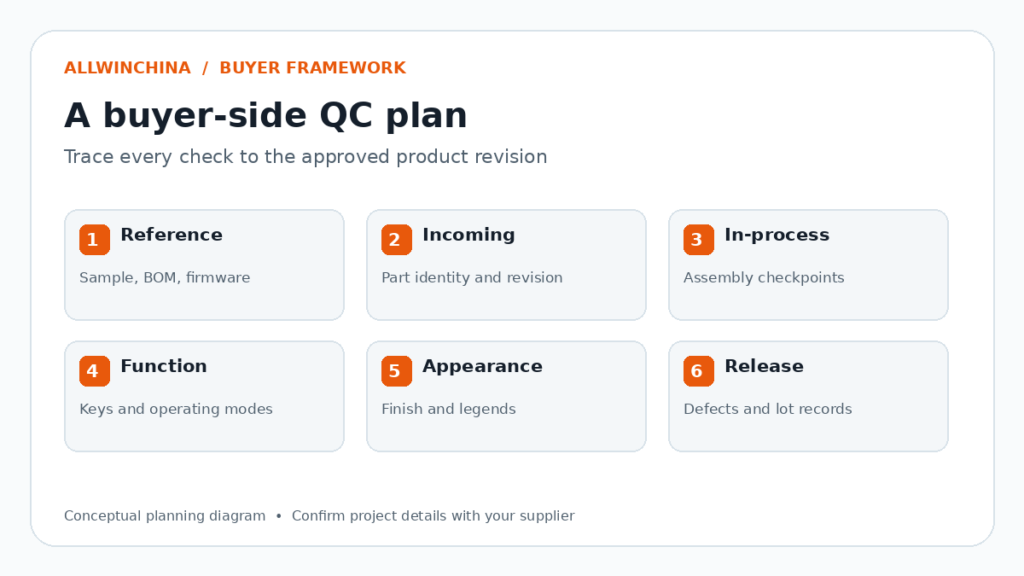
Keep the approved sample, BOM, drawings, color references, legend artwork, firmware build and packaging specification under revision control. Label the physical sample and record who approved it and when. Without that baseline, “the production keyboard is different” is difficult to resolve. The same principle applies to supplier-approved component substitutions: document what changed before parts enter the line. If you are still collecting requirements, start with the RFQ checklist.
Separate critical, functional and cosmetic criteria
Write criteria that an inspector can observe and record. Critical items may include electrical safety or market-specific compliance requirements determined by your product and destination. Functional checks may cover every key position, connection modes, charging behavior, indicators, firmware configuration and accessory fit. Cosmetic checks may cover case finish, scratches, legends, alignment, color variation and packaging. Do not use the same pass/fail language for every item: define the test method and acceptance limit for each.
Put checks at the right stage
- Incoming materials: verify part identity, revision and visible damage before assembly. For critical parts, agree what supplier certificates or incoming tests are required.
- In-process assembly: check orientation, fastening, soldering or connector seating at the point where a mistake can still be corrected efficiently.
- Finished-unit function: test the keyboard’s defined operating modes and every key position using an agreed method. If firmware is configurable, record the tested version and configuration.
- Appearance and pack-out: compare finish and legends against approved references; verify included accessories, labeling and carton contents.
- Pre-shipment release: review inspection results, unresolved defects, rework records and the shipment quantity before authorizing dispatch.
For designs using QMK, the official QMK documentation is a reference for firmware behavior and configuration; not every OEM keyboard uses QMK, so the test plan must name the actual firmware platform.
Specify the evidence you expect
Ask for a report that identifies the production lot, sample or unit IDs, test date, inspector, method, limits, results and disposition of failures. Photos help with cosmetic issues, but they cannot prove that every key or connection mode passed. For a recurring defect, request the cause, corrective action and evidence that the reworked units were retested. An inspection report is only useful if it can be traced to the goods being shipped.
Use sampling carefully
Sampling reduces the number of units inspected; it does not guarantee that every unit in the lot is good. Decide which characteristics require 100% functional testing and which may be checked by a defined sample plan. If the supplier proposes an AQL or another acceptance-sampling method, ask for the exact standard, inspection level, sample size and defect classifications. Do not accept “AQL passed” as a complete answer without knowing what was tested and what counted as a defect.
Agree what happens when the plan finds a problem
Define hold, rework, retest and release decisions before production begins. Who can approve a deviation? Does the buyer need to sign off on a cosmetic exception? Is replacement or rework possible without changing the shipment date? These questions belong in the purchase agreement and quality plan, not in a last-minute chat after inspection. Use the project timeline to reserve time for inspection and correction.
Buyer checklist before release
Before authorizing shipment, confirm that the approved revision matches production, the required tests have results, open defects are dispositioned, packaging and labels match the agreed specification, and the shipment documents identify the same lot. A QC plan is not a promise of zero defects; it is a way to make quality expectations testable and decisions accountable.
Planning an OEM/ODM run? Send us your product brief and quality questions. We can discuss which checkpoints should be defined before samples and production are approved.